When You Need Answers and the Answers Won't Come
Aug 17, 2026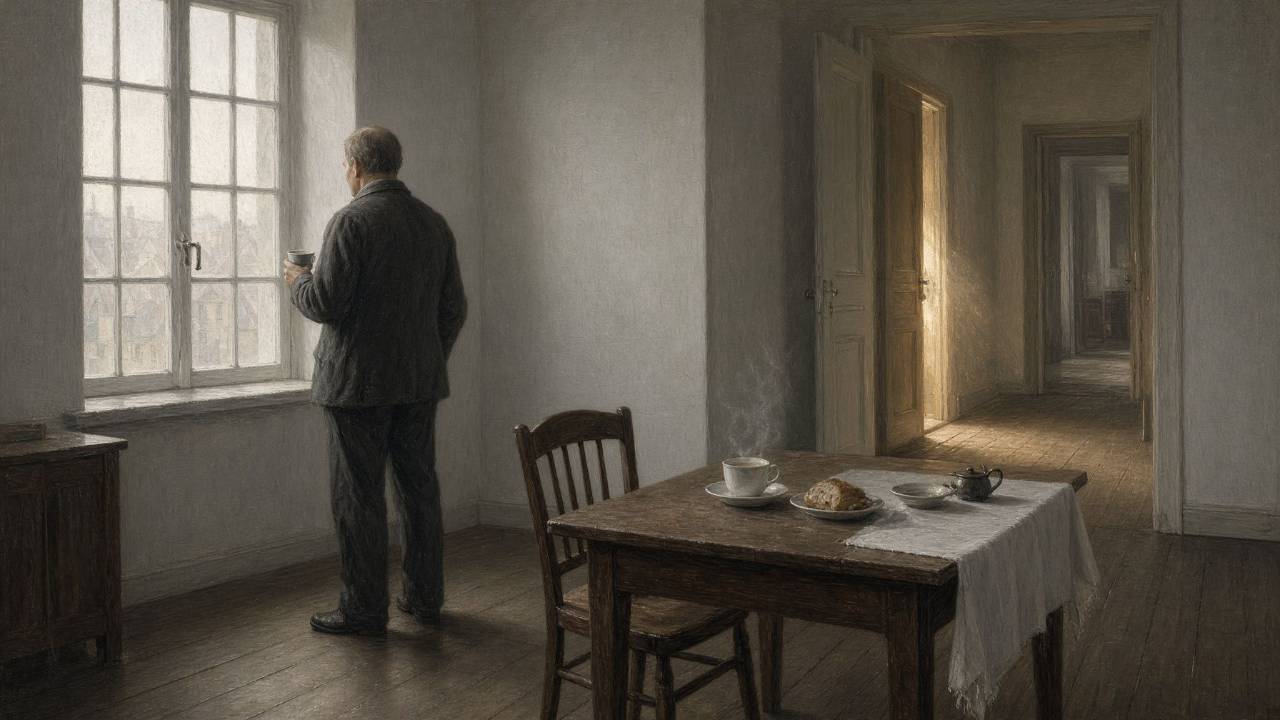
It's 1:47 in the morning, and a good man is lying awake next to his wife, composing a question.
He's been drafting it for weeks. It's a simple question, he tells himself. A fair question. Something like: "I just need to know where we stand. Are you in this or not?" He's polished every word. He's imagined asking it calmly, reasonably, over coffee, like a man who has his act together. And he genuinely believes that once he asks it, and once she answers it, the thing eating him alive will finally stop eating.
I've sat with a lot of men like him. One of them put the underneath of it into words better than any textbook I've read. He said, "Life is relationships. Everything else is noise. And at some point I need clarity. The ambiguity is eating at me."
I want to tell you what I told him, because I've rarely met a sentence that was so beautifully half right.
The Half He Got Right
Life is relationships. Everything else is noise.
Write that down somewhere, because it's true, and most people spend decades learning it the expensive way. The career, the house, the numbers in the accounts: all of it is scaffolding around the actual building, which is the people you love and how well you love them. When people are dying, they don't ask for their trophies. They ask for faces. He had that part exactly right, and it's why the ambiguity in his marriage hurt so much. He wasn't in pain because he valued the relationship too little. He was in pain because he valued it correctly.
But then comes the second half. At some point I need clarity. I need the verdict. I need to know.
And that's the trap. It looks like strength. It functions like a demand. And it almost never gets you the truth.
The Clarity Trap
Here's what's actually happening when we say "I just need to know where we stand." Underneath the reasonable words, we are usually asking the other person to do a job that was never theirs: resolve my anxiety for me. Make the churning stop. Hand me a verdict so I can finally exhale.
The question sounds fair. But look at what it hands the other person. If they're uncertain, and uncertain is usually exactly what they are, the question gives them an impossible choice: manufacture a verdict they don't actually have yet, or crush you on the spot. So what do pressed people do? They give protective answers. They say what ends the conversation, not what's true. Sometimes they say "of course I'm in" to buy peace. Sometimes they say "maybe we're done" because pressure feels like proof that it's broken.
Either way, hear this: an answer extracted under pressure is the answer fear gives. It is not the answer love might have given with time. When you force the verdict, you don't get clarity. You get a snapshot of someone's anxiety, notarized.
Who You Become When Nothing Is Guaranteed
There's a researcher named Pauline Boss who spent her career studying what she calls ambiguous loss: the grief that has no funeral. The soldier missing in action. The parent with dementia, present in body and absent in memory. And yes, the spouse who is physically here and emotionally uncertain. Boss found that this is the hardest kind of loss precisely because it never closes. And her prescription surprised everyone. The way through is not to force closure. It's to grow the capacity to hold two things at once: this may work out, AND it may not. Both held. Neither collapsed into.
That's not weakness. That's the actual test. Anyone can commit when the outcome is guaranteed. Anyone can be loving when the verdict came back in their favor. The question your ambiguous season is asking you is different: who do you become when nothing is promised? Because that man, the one you become inside the not-knowing, is the man you actually are.
Solomon wrote, "Trust in the Lord with all your heart; do not depend on your own understanding." (Proverbs 3:5, NLT) I used to read that as a nice thought. Now I read it as a direct confrontation, because the demand for clarity is almost always a demand to lean on my own understanding. Give me the data. Give me the verdict. Give me something I can control. Trust is what's left when the verdict won't come, and it turns out that's the only place trust ever really grows.
Love Needs Today. Hope Needs an Outcome.
Here's the distinction that changes men, and I've watched it happen.
Hope, at least the way we usually practice it, needs an outcome. It feeds on a particular ending. She comes back around. The distance closes. The verdict lands in my favor. And because hope needs that ending, every neutral day becomes evidence to analyze, every sigh becomes a data point, and you end up living in an imagined future courtroom instead of your actual kitchen.
Love is different. Love just needs today. Love can make her coffee this morning without needing to know what October holds. Love can notice something true and kind and say it out loud with no agenda riding on it. Love can be fully present at dinner tonight even though the question is still open, because love isn't waiting for the answer to start. It already started.
Jesus put it like this: "Give your entire attention to what God is doing right now, and don't get worked up about what may or may not happen tomorrow." (Matthew 6:34, MSG) That's not a verse about ignoring your marriage's problems. It's a verse about where your attention actually has power. Today. That's the whole inventory.
When a man stops feeding on hope for a particular ending and starts simply loving the person in front of him, something surprising happens. Peace shows up before clarity does. Not because the situation resolved, but because he stopped demanding that it resolve on his schedule.
Alignment, Trust, and Commitment, Revisited
That same man gave me three words for what a relationship comes down to: alignment, trust, and commitment. Good words. But each one carries a twist that changes everything.
Alignment isn't agreement. John Gottman's research found that 69 percent of the conflicts in a marriage are perpetual. They never fully resolve, in any marriage, including the great ones. Healthy couples don't achieve alignment on everything. They achieve dialogue about the things they'll never align on. If you're waiting to feel fully aligned before you feel secure, you're waiting for something no marriage on earth has.
Trust isn't a verdict you demand. It's a climate you build. It's made of small credible actions repeated over time: the kept promise, the honest answer, the showing up. You can't extract a climate from someone in one conversation at 1:47 in the morning. You can only contribute to it, one ordinary day at a time, and let the weather change slowly.
And commitment. Here's the hard one. Commitment gets tested precisely in the seasons when the other person can't match it. That's not a design flaw in commitment. That's what commitment is for. A vow that only holds when it's reciprocated in real time isn't a vow. It's a transaction with better lighting.
My Own Late-Night Drafting
I'd love to tell you I write this from the far shore, but the wounded healer doesn't get that luxury. I know the 1:47am drafting session personally. I have lived seasons where my need to know, to fix, to resolve, was dressed up as leadership when it was really just an inability to tolerate discomfort. I wanted the churning to stop, and I wanted someone else's answer to stop it.
I still fight that urge. Surrender, I've learned, is not a diploma you frame once. It's a daily practice, and some days I practice it badly. But I can tell you the direction of travel: every year I get a little better at letting today be enough, and every year the questions lose a little more of their teeth.
And here's something I can only say because I've lived it, so please hear it with all the gentleness I mean it with. Time really does heal. Wounds, confusion, even seasons that look unresolvable from the inside. But time can only do its healing work when we live in acceptance, and acceptance is exactly the thing the verdict-hunt refuses. When we force the timeline, we're not speeding up the healing. We're interrupting it.
Which brings me to the hardest sentence in this article, and I'm saying it to myself as much as to you. When I catch myself saying "I can't keep doing this," what I'm usually saying underneath is "I can't fully trust that Jesus will take care of me regardless of how this turns out." That one stings, I know. It stung me the first time I saw it in my own mirror. Because I wasn't just tired of the ambiguity. I was carrying the whole outcome on my own shoulders, as if my future depended on her answer instead of His faithfulness. Friend, if that's where you are tonight, there's no shame in it. I've been exactly there. But the invitation hiding inside your exhaustion isn't to finally force the verdict. It's to finally put down the outcome, and let it rest in hands that were always stronger than the question.
One Guardrail Before You Go
Now, before anyone hears me wrong: living with ambiguity is not the same as living without boundaries. I am not telling you to tolerate anything forever, absorb mistreatment quietly, or let a marriage stay in a fog for a decade because patience is holy. Boundaries still stand. Truth still gets spoken. Some situations genuinely require a defined conversation, and some require help.
The difference is this: a boundary protects your health. A verdict-hunt protects you from discomfort. One is about what you will live with. The other is about what you can't sit with. Learn to tell them apart, and refuse to let your anxiety be the one setting the timeline.
A Practice for This Week
Take the question that's eating you, the one you keep drafting, and give it a better room. Write it in a journal. Bring it to a coach or a pastor. Pray it out loud with the anger left in. The question deserves to exist. It just doesn't belong dropped on the person who can't answer it yet.
Then, once a day this week, give your spouse something with no agenda attached. An appreciation. A kindness. A moment of full presence at dinner. Not as a strategy to win a verdict. As a practice of loving today, because today is the only place love actually lives.
And each night, try Boss's both/and out loud, just once: "This may work out, and it may not, and I can be a whole man either way." It will feel strange the first few nights. Somewhere around night five, it starts to feel like breathing.
If You're in the Not-Knowing Right Now
If this found you at 1:47 in the morning, I want you to know the ambiguity doesn't have to eat you. This is exactly the work I do with men and women in my personal coaching program: one hour at a time, we build the strength to live well inside the season you didn't choose, doing your own work whether or not anyone joins you in it yet.
Learn about personal coaching here
And if you want to do that work alongside other people walking through their own uncertain seasons, our Sojourners community meets twice a week, and it's full of people who understand the not-knowing from the inside: join us here.
Or just text me at (303) 435-2630 or email [email protected].
What's the question you've been drafting at 1:47 in the morning? You don't have to share the details. Just tell us in the comments: are you living in the courtroom, or in the kitchen?
Discover the hidden relationship killer destroying most marriages (and how to stop it).
Join me twice a week for real transformation!
I'll send you proven strategies for your marriage, spiritual growth, trauma healing, and recovery. No generic advice—just what actually works from 30+ years in the trenches.
I hate SPAM. I will never sell your information, for any reason.