The Holy Spirit Lives In You. Brother Lawrence Met Him in the Dishes.
Jun 16, 2026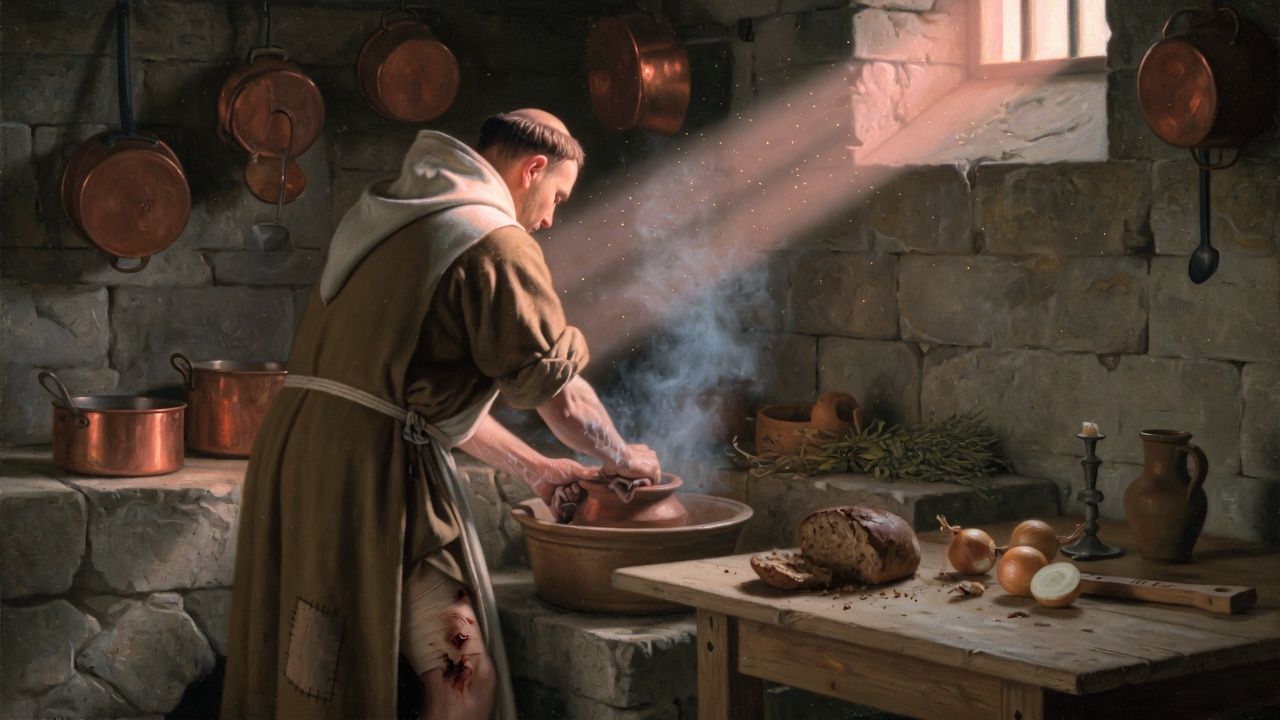
There was a man in 17th century France who washed dishes for thirty years and became one of the most spiritually wise people who has ever lived.
His name was Nicolas Herman. The world remembers him as Brother Lawrence.
He wasn't a theologian. He wasn't a priest. He wasn't a celebrated mystic with a robe and a following. He was a former soldier with a bum leg who couldn't do much else, so the monastery put him in the kitchen. For three decades. Pots and pans. Soup. Bread. Scrubbing. Stirring. Dishes piled to the ceiling. Day after day after day.
And somewhere in that kitchen, surrounded by greasy dishwater and the smell of onions, Brother Lawrence met the Holy Spirit.
Not in a moment of mystical ecstasy. Not in a vision. Not in a special holy assignment. In the dishes.
He wrote later that he was as close to God scrubbing a pot as he was on his knees during corporate prayer. He called it "the practice of the presence of God." And what he discovered there, in the most ordinary place imaginable, is what I want to talk to you about today.
The Holy Spirit is not waiting for you at a higher altitude.
He's already in the kitchen. He's already in your nervous system. He's already in the room. And He has been whispering to you for years inside the most mundane moments of your life. You just weren't taught to notice.
Welcome to the fifth article in the Loved series. We've covered the Heart of the Father and the Mind of the Son. Now we move into Part Three. The Presence of the Holy Spirit.
This is where ancient theology meets your actual body. And it's where Brother Lawrence is going to be our guide.
The Spirit Lives Inside You
Let's start with something the church has talked about for two thousand years but most of us still haven't really absorbed.
The Holy Spirit doesn't live in the heavens. He doesn't live in the church building. He doesn't live in the worship service. He doesn't even live in your Bible.
He lives in you.
"Don't you realize that your body is the temple of the Holy Spirit, who lives in you and was given to you by God?" (1 Corinthians 6:19 NLT)
Your body. His temple. Not metaphorically. Geographically. He lives in your chest. In your gut. In your nervous system. In the very wiring that fires when you get triggered or scared or exhausted.
Brother Lawrence figured this out three hundred and fifty years before neuroscience caught up. He realized that there was no sacred place that was holier than where he was already standing. Because the Spirit was inside him. Walking with him. Working with him. The kitchen wasn't a step down from the chapel. The kitchen was just as full of God because Brother Lawrence was.
For some of you that's freeing. You don't have to wait for the worship song to hit just right or the sermon to land or the retreat weekend to come around. The Spirit is already inside you. Now. As you read this. Closer than your breath. Closer than your skin.
For others of you, that's terrifying. Because the idea of God living inside you sounds suspicious. Like maybe He's monitoring you. Like maybe He's keeping a record of your bad thoughts. Like maybe being closer means being more easily disappointed.
That's not the Spirit you're picturing. That's a security camera with theology bolted on. The Holy Spirit does not live in you to monitor you. He lives in you to be with you. To hold you. To advocate for you. To pray for you when you can't pray for yourself.
The Spirit Prays For You When You Can't
This is one of the most underpreached verses in the entire Bible. Read it carefully.
"And the Holy Spirit helps us in our weakness. For example, we don't know what God wants us to pray for. But the Holy Spirit prays for us with groanings that cannot be expressed in words." (Romans 8:26 NLT)
Groanings. Not eloquent prayers. Not polished liturgy. Not "Dear Heavenly Father, I come before you today." Groanings. The raw, guttural, sub-verbal sound that comes from a place deeper than language can reach.
Have you ever been in so much pain that you couldn't form a sentence? Where the only thing that came out was a sound? A moan. A cry. Something that wasn't words but WAS communication?
That's what the Holy Spirit does on your behalf. When your soul is making sounds that your mouth can't translate, He takes that and brings it to the Father. Not cleaned up. Not edited. Not made presentable. He brings the groan itself. And the Father understands it perfectly.
"And the Father who knows all hearts knows what the Spirit is saying, for the Spirit pleads for us believers in harmony with God's own will." (Romans 8:27 NLT)
You have never been without a voice. Even when you had no words.
There were nights you cried yourself to sleep and didn't know what to say. The Spirit was praying for you.
There were mornings you woke up exhausted before the day even started. The Spirit was praying for you.
There were moments after the divorce, after the diagnosis, after the funeral, after the betrayal, when prayer felt like throwing pebbles at a closed window. The Spirit was praying for you.
He has been keeping the conversation going between you and the Father this whole time. Even when you didn't know He was. Even when you didn't believe He was. Especially then.
The Spirit as Co-Regulator
Now I want to take a step into modern science, because this lesson is one of the most beautiful intersections of ancient theology and current neuroscience I've ever found.
Your nervous system has three basic states. Calm and connected, which is your window of tolerance. Activated and ramped up, which is fight or flight. Shut down and collapsed, which is freeze. When you get pushed outside your window of tolerance, the thinking part of your brain dims. The survival brain takes over. React. Protect. Fight. Run. Freeze.
Decades of research have shown us something important. You cannot reliably regulate yourself out of a survival state by yourself. Not when you're truly activated. You need a co-regulator. You need a calm, safe presence whose nervous system communicates safety to yours.
This is why a baby stops crying when a parent holds them. The parent's calm nervous system communicates safety to the baby's through touch, tone, breath, and presence. The baby doesn't think their way back to calm. They feel their way back through the co-regulating presence of someone safe.
Adults work the same way. When you're activated and someone safe sits with you, doesn't panic, doesn't try to fix you, doesn't get activated by your activation, but just stays calm and present, something in your nervous system gets the message: "Okay. We're safe. We can come down now."
That's co-regulation. It's not a technique. It's a relationship.
Now here's the part that changes everything. The Greek word for the Holy Spirit in John 14 is parakletos. It means "the one called alongside."
"And I will ask the Father, and he will give you another Advocate, who will never leave you. He is the Holy Spirit, who leads into all truth." (John 14:16-17 NLT)
The one called alongside. Walking next to you. Matching your pace. In step with you. Even when your pace is stumbling.
When you're activated, when your chest is tight and your thoughts are racing and your breath is shallow and you can't find ground, the Holy Spirit is not standing at a distance waiting for you to calm down so you can pray properly. He is in the activation with you. He is the calm presence in the room when everything else is on fire.
You always have a co-regulator available. Always. Not just when a friend picks up the phone. Not just when you can get to your therapist's office. Always. At 3am when the thoughts won't stop. In the car when the panic hits. In the middle of the argument when your brain goes offline. In the quiet moment after the crisis when the shaking starts.
He is there. Not as an idea. As a presence. As a nervous system-level reality that your body can learn to receive.
Brother Lawrence in the Kitchen
This is where Brother Lawrence becomes a teacher for the rest of us.
He wasn't a saint by birth or by training. He came to the monastery in his thirties after a difficult life. He had been a soldier, wounded in the Thirty Years War, left with a leg injury that gave him pain for the rest of his life. He worked as a household servant before joining the Carmelites as a lay brother. The monastery put him in the kitchen because of his bad leg. Not because of his spiritual gifts.
And for the first ten years, he was miserable.
This is the part of his story most people skip. Brother Lawrence didn't float into the Practice of the Presence of God. He fought his way into it. For ten years he wrestled with the idea that he wasn't holy enough. That his prayers were inadequate. That God was disappointed in him. He performed religion. He kept the rules. He attended the services. And he felt nothing.
Then something shifted. He stopped trying to find God in a different place than where he was already standing.
He realized that the divide he had been making between "sacred time" (prayer, mass, devotions) and "ordinary time" (work, dishes, errands) was a divide that didn't exist in God's mind. The kitchen wasn't a lesser space. The dishes weren't a distraction from God. They were the place where he could practice being with God.
So he started doing exactly that. Every dish became an act of worship. Every pot a chance to turn his attention inward toward the Spirit who lived there. He didn't say grandiose prayers. He didn't recite formal liturgy. He just kept turning back, again and again, to the awareness that he wasn't alone in the kitchen. The Spirit was right there. With him. In him. Working alongside him as he chopped vegetables.
He wrote later: "The time of business does not differ with me from the time of prayer; and in the noise and clatter of my kitchen, while several persons are at the same time calling for different things, I possess God in as great tranquility as if I were upon my knees at the Blessed Sacrament."
In the noise and clatter of the kitchen. While people were calling for different things. He possessed God in tranquility.
That's a co-regulated nervous system in seventeenth-century language.
He had figured out, through years of practice, that the Spirit was always there. Always available. Always communicating peace to his body. He didn't have to leave the kitchen to find God. He had to learn to notice God in the kitchen.
For thirty more years, that's what he did. Wash, turn his attention inward, peel, turn his attention inward, stir, turn his attention inward, serve, turn his attention inward. Over and over. A simple, repetitive, almost embarrassing spiritual practice. And it formed him into one of the most peaceful men anyone in his monastery had ever met.
After he died, the abbot of the monastery collected the letters Brother Lawrence had written and the conversations people remembered having with him. The little book they published, The Practice of the Presence of God, has been in print for over three hundred years and is still recommended by spiritual teachers across denominations as one of the most important texts on intimacy with God ever written.
Written by a dishwasher.
That's the Holy Spirit. He doesn't need you to be a theologian to teach you what theologians can't figure out. He needs you to turn your attention inward, in your kitchen, in your car, in your living room, in your office. And He'll meet you there. Every time.
Why Some of You Can't Feel Him
Now I have to address the question some of you are asking right now.
"That sounds amazing. But I can't feel Him. I never have. What's wrong with me?"
Nothing. Hear that first. Nothing is wrong with you.
There are real reasons why feeling the Spirit's presence is harder for some of us than others.
If you grew up with chronic stress or trauma, your nervous system learned that safety isn't real. So when the Spirit tries to communicate safety, your body doesn't trust it. The signal is being sent. The receiver is just guarded. That's not a spiritual failure. That's a nervous system that learned what it had to learn to survive.
If you grew up with a critical or harsh parent, the idea of an "internal presence" feels like surveillance, not companionship. Your body is bracing for judgment. The Spirit is offering peace. The wires got crossed by the people who were supposed to be safe and weren't.
If you've been performing spirituality for years, you might have built up so much religious noise that you can't hear the whisper underneath. Brother Lawrence had to clear ten years of performance before he could finally hear what was always there. You might need to clear some too.
The Spirit isn't withholding from you. He's been there all along. Your job isn't to make Him show up. He already has. Your job is to slowly, patiently, gently rebuild your capacity to receive what's already being offered.
The Wind, the Earthquake, the Fire, and the Whisper
There's a story in the Old Testament that I think about almost every day.
Elijah had just won the biggest spiritual victory of his life. He had called down fire from heaven on Mount Carmel. He had defeated 450 prophets of Baal in one of the most dramatic showdowns in the entire Bible. He should have been on top of the world.
Forty days later, he was hiding in a cave, asking God to let him die.
"He came to a cave, where he spent the night. But the LORD said to him, 'What are you doing here, Elijah?' Elijah replied, 'I have zealously served the LORD God Almighty. But the people of Israel have broken their covenant with you, torn down your altars, and killed every one of your prophets. I am the only one left, and now they are trying to kill me, too.'" (1 Kings 19:9-10 NLT)
Big victory followed by total crash. Burnout. Despair. The voice in his head telling him he was alone, that everyone was against him, that his story was over. Sound familiar to anyone?
God's response to Elijah is one of the most pastoral moments in all of Scripture. He didn't rebuke him. He didn't quote Scripture at him. He sent him an angel with bread and water and told him to sleep. Twice. Then He told him to walk to a mountain.
And then this happened.
"'Go out and stand before me on the mountain,' the LORD told him. And as Elijah stood there, the LORD passed by, and a mighty windstorm hit the mountain. It was such a terrible blast that the rocks were torn loose, but the LORD was not in the wind. After the wind there was an earthquake, but the LORD was not in the earthquake. And after the earthquake there was a fire, but the LORD was not in the fire. And after the fire there was the sound of a gentle whisper." (1 Kings 19:11-12 NLT)
The wind. The earthquake. The fire. And God was in none of them.
Then a whisper.
That's where God was. In the whisper. In the gentle, quiet, almost-missable sound after the loud things had passed.
I think this is one of the most important passages in the entire Bible for people in our generation. Because everything in our culture trains us to look for God in the wind, the earthquake, and the fire. The dramatic. The big. The loud. The moving worship service. The conference. The vision. The breakthrough.
But God most often isn't in those things.
He's in the whisper.
He's in the moment of stillness when you wake up at 3am and instead of grabbing your phone, you breathe. He's in the gut feeling that says "don't say that." He's in the verse that comes to mind when you didn't ask for one. He's in the peace that settles after you finally tell the truth. He's in the quiet knowing that you should call that person you've been meaning to call.
These small whispers are the primary way God communicates with most of us. Most of the time. And we miss them because we're listening for the wind.
Three Voices, One Test
Here's something I want you to keep in your back pocket. There are three voices that compete for space in your head, and you need to know how to tell them apart.
Shame sounds like this: "You're such a failure. You'll never change. What's wrong with you? Everyone else has it figured out. God is disappointed in you. You don't belong here."
Shame is loud. Harsh. Absolute. It speaks in "always" and "never." It attacks your identity. It loops endlessly. And it leaves you feeling smaller, more hopeless, and more isolated than before.
Anxiety sounds like this: "What if this happens? What if that happens? You're not safe. Something is wrong. You need to fix this right now. If you don't figure this out, everything will fall apart."
Anxiety is loud. Urgent. Future-oriented. It spins scenarios. It creates a feeling of emergency even when there is no emergency. It lives in the "what if" and never in the "what is."
The Spirit sounds like this: "You're okay. I'm here. Take a breath. You don't have to figure this out right now. Let's be still for a moment. I see you and I love you. That pattern you just noticed? Let's look at it together. You're not alone."
The Spirit is quiet. Gentle. Present-tense. He speaks to what IS, not what might be. He invites reflection, not rumination. He convicts without condemning. He challenges without attacking. And He always, always leaves you feeling more settled, more seen, and more connected than before.
Here's the test. After hearing a voice in your head, ask yourself: do I feel smaller or more whole? Am I more afraid or more settled? Am I spiraling or am I grounding?
If the voice sends you into a loop, it's not the Spirit. If the voice brings you back to the present moment, pay attention. That's Him.
What God Did With Elijah Next
I love this part of the story because it shows you what the Spirit does after He whispers.
After the whisper, God asked Elijah a question.
"'What are you doing here, Elijah?'" (1 Kings 19:13 NLT)
It's the same question He asked Hagar in the wilderness. The same question He asked Adam in the garden. "Where are you? What are you doing here?" Not because He doesn't know. Because being asked is being seen. And being seen is the first step toward being sent.
Elijah answered honestly. He told God he was the only one left. That everyone had abandoned the cause. That he was alone and afraid and done.
God did two things. He corrected the lie. There were seven thousand others in Israel who hadn't bowed to Baal. You are not as alone as you think. And then He gave Elijah an assignment. Next steps. Purpose. Direction.
But notice the order. Sleep first. Food first. The whisper first. The question first. The honest answer first. And then the assignment.
God does not give you next steps while you're under the tree dying. He feeds you. Rests you. Whispers to you. Asks you what's going on. Listens to your answer. And then tells you where to go.
That's the pattern. That's the Spirit's pastoral order. Always.
A Practice for This Week
Brother Lawrence would tell you to do something embarrassingly simple this week. Practice the presence.
You don't have to add anything to your schedule. You don't have to wake up early. You don't have to find a quiet retreat center. You don't have to clear your calendar.
You just have to start turning your attention inward, throughout your ordinary day, toward the Spirit who already lives there.
In your car. Stop the podcast for one minute. Breathe. Whisper "Holy Spirit, I know you're here." Then go back to driving.
At the kitchen sink. While you're washing dishes. Let yourself notice that you are not alone. He is there. With you. In the most mundane chore of your week.
At your desk. Between meetings. Before opening the next email. One conscious breath. One quiet acknowledgment. I'm not alone in this.
In bed at night. Before sleep takes you. Lay your hand on your chest. Feel your own breath. And remember: He lives inside the body that is currently lying in this bed. He is closer than your skin.
You won't always feel anything. That's fine. The point isn't the feeling. The point is the practice. You are slowly, patiently, gently rebuilding your awareness of a Presence that has been with you all along.
And one more practice. This week, listen for the whisper. Set aside ten minutes each day. Find a quiet place. Don't bring a prayer list. Don't bring an agenda. Just sit. Let the noise pass. And see what surfaces underneath it.
Some days nothing will seem to happen. That's okay. You're building the muscle of stillness. And the whisper often comes later. In the car. In the shower. At 3am. After you've created enough quiet that the Spirit has room to speak.
Shame is loud. Anxiety is loud. The Spirit is quiet.
Get quiet enough to hear Him. He's been whispering your name.
You Don't Have to Do This Alone
This is the fifth article in the Loved: The Father Pursued You, the Son Found You, the Spirit Stayed series. One more to go. The final article will tie the whole series together by answering the question that's been quietly haunting some of you since Article 1: now that I know God loves me, how do I actually live in it?
If you want to do this work in community instead of by yourself, come join the Smalley Sojourners. We meet twice a week on Google Meet, encourage each other through a WhatsApp group, and we are walking through this exact study together in real time. The room is small, the conversation is honest, and there is still room for you.
You can join at smalleyinstitute.com/offers/FEfWKzN7/checkout.
Or text me at (303) 435-2630 or email [email protected] if you want to talk through anything in this article. I read every message.
Where in your ordinary life have you been missing the whisper? What dishes have you been washing without realizing He was right there with you? Drop a comment, send me a note, or just say "me too" if this landed. You are not alone in this.
Discover the hidden relationship killer destroying most marriages (and how to stop it).
Join me twice a week for real transformation!
I'll send you proven strategies for your marriage, spiritual growth, trauma healing, and recovery. No generic advice—just what actually works from 30+ years in the trenches.
I hate SPAM. I will never sell your information, for any reason.